
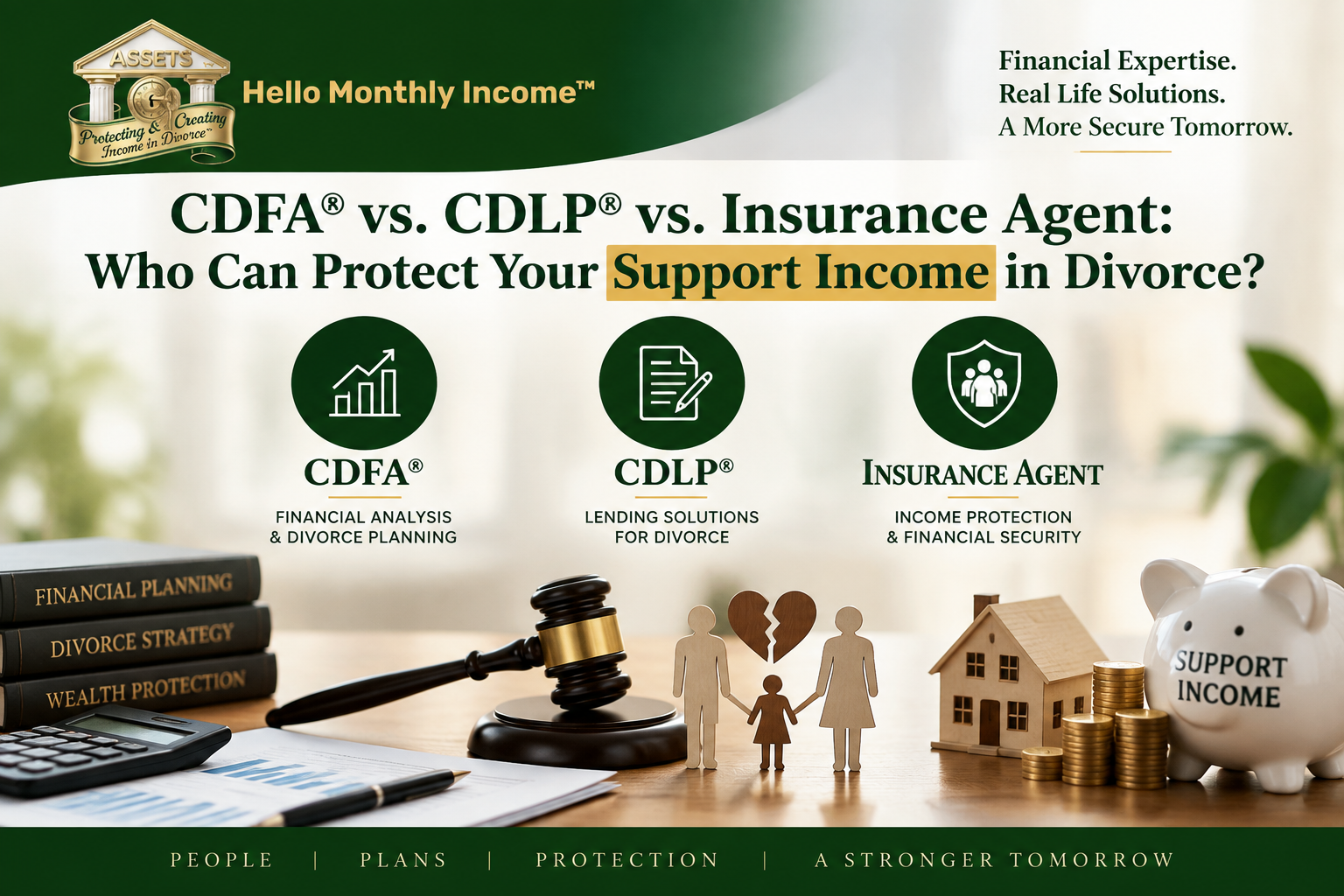
When you’re trying to make sure your receipt of alimony or child support payments are actually protected, you’ll run into a confusing wall of credentials and job titles. A CDFA®. A CDLP®. A licensed insurance agent. A financial advisor. They all sound like they could help, and each one might be able to handle some piece of the puzzle. But protecting your support income isn’t one task, it’s several, and most of these professionals only cover a portion of it.
This article breaks down what each credential actually does, where each one stops, and why protecting your receipt of alimony and child support payments usually requires someone who holds more than one credential. If you understand the differences, you’ll know exactly who you need, and you’ll avoid the common mistake of assuming one professional has the whole thing covered when they don’t.
What a CDFA® Does (and Where It Stops)
A Certified Divorce Financial Analyst (CDFA®) is trained in the financial aspects of divorce. That means understanding how alimony and child support payments are calculated, how assets and debts get divided, how tax consequences play out, and how to analyze whether a proposed settlement agreement actually works over the long term rather than just on the day it’s signed.
For protecting your support income, the CDFA®’s value is the analysis. A CDFA® should be able to determine the true present value of your alimony and child support, which is the essential starting point. You can’t protect an income stream correctly until you know exactly how much it’s worth across all the years it’s supposed to last.
Where it stops: a CDFA® credential, on its own, is about analysis and planning, not execution. It doesn’t make someone licensed to place an insurance policy or to structure a mortgage. A CDFA® can tell you that your support income needs protection and roughly how much protection you need, but the credential alone doesn’t let them place the coverage.
What a CDLP® Does (and Where It Stops)
A Certified Divorce Lending Professional (CDLP®) specializes in how divorce intersects with mortgages and lending. This covers how divorce-related income like alimony and/or child support is treated by mortgage underwriters, how to time and structure a refinance around a divorce, and how to help the spouse keeping the marital home actually qualify for financing.
For protecting your support income, the CDLP® angle matters when a home is involved, because your alimony and child support are often the very income a lender looks at when deciding whether you qualify to keep the home. Protecting that income and using it to qualify for a mortgage are closely linked, and a CDLP® understands both sides.
Where it stops: the CDLP® credential is focused on the lending and mortgage-qualification side. It’s essential if keeping the home is part of your situation, but on its own it doesn’t cover placing life or disability insurance to guarantee the support income survives a death or disability. Additionally, CDLP®s are not typically qualified to do the present value calculations to determine what the correct amount of coverage should be.
What a Licensed Insurance Agent Does (and Where It Stops)
A licensed life and disability insurance agent can actually place the policies that protect your receipt of support income. This is the execution piece the credentials above don’t include. An agent can issue a life insurance policy on your paying ex-spouse so that alimony and child support continue if they die, and a disability policy that protects the income if they can no longer work.
For protecting your support income, this is the part that turns a plan into actual protection. Analysis and planning don’t guarantee anything until a policy is in force.
Where it stops: this is the critical catch. Most licensed insurance agents are generalists. They sell across auto, home, life, and health, and the overwhelming majority have no divorce training or divorce experience whatsoever. A general agent can sell you a life insurance policy, but typically won’t know how to size the coverage to your specific support obligation, how to structure ownership so your ex-spouse can’t quietly cancel it, how to set the beneficiary designation to actually protect you, or how to coordinate with the divorce attorney to make sure all the requirements are incorporated into your Divorce Settlement Agreement. A policy that isn’t structured for a divorce context can give you a false sense of security while leaving real gaps that might only reveal themselves when it’s too late.
Why No Single Credential Is Enough
Here’s the core problem: protecting your receipt of alimony and child support payments touches all three areas at once. You need the CDFA®’s analysis to calculate the present value of all the support obligations, the insurance agent’s license to actually place the coverage, and often the CDLP®’s lending knowledge if the marital home is in the picture. Each credential solves one slice, and all the slices have to fit together.
In practice, this is where most people get caught. They rely on their divorce attorney for the legal agreement, maybe a general insurance agent for a policy, and maybe a financial advisor for investments, and they assume the pieces add up to full protection. But nobody in that chain owns the specific job of making the insurance coverage match all the support obligations and making it legally enforceable. The analysis says one thing, the policy says another, and the settlement language never quite ties them together. The gaps between the specialists are exactly where support income gets lost.
Why the Big Firms Don’t Close the Gap
You might expect a large firm to solve this by having all the specialists under one roof. In practice they rarely do, at least not in a coordinated way. A national lender like Rocket Mortgage can write a mortgage but isn’t structuring divorce insurance. A big insurance carrier like Northwestern Mutual or State Farm can sell a policy but isn’t running divorce financial analyses or settlement coordination. A wealth manager at a major firm can plan investments but usually doesn’t have any divorce training or any real-life experience with divorcing clients and their divorce attorneys.
Each of them can theoretically provide a piece. But for all of them, protecting divorce support income is a side task, not the specialty, so the coordination that actually matters, tying the analyses, the coverage, and the settlement language together, falls through the cracks. That coordination is the entire job, and it’s precisely what a dedicated divorce insurance specialist exists to do.
How Hello Monthly Income™, LLC Combines All Three
Hello Monthly Income™, LLC was founded by Jeffrey A. Landers, CDFA®, CDLP®, whose credentials cover all three areas at once. He is a Certified Divorce Financial Analyst, a Certified Divorce Lending Professional, and a licensed life, disability and annuity insurance agent, as well as a licensed real estate and mortgage broker. That combination is unusual, and it’s the whole point: he can run the financial analyses to value your support income, place the insurance to protect it, and coordinate the mortgage side if you’re keeping the home, without handing pieces off to separate professionals who don’t talk to each other.
The experience behind those credentials is substantial. Jeff holds over 40 years of combined experience across divorce financial advisory, insurance, real estate, and mortgage lending, and since 2010 he has personally advised on more than 1,000 divorce cases nationwide. He is the author of 8 published books on the financial aspects of divorce, wrote the “Divorce Dollars and Sense” blog that ran on Forbes.com, and has been featured in The Wall Street Journal, CBS and FOX television news, Consumer Reports, and many others. You can read his full background here.
Because protecting and creating income in divorce is the entire business at Hello Monthly Income™, LLC, not one service buried inside a larger operation, the coordination between the three disciplines is built in rather than left to chance.
Which One Do You Need?
If your only concern is understanding whether your settlement is financially sound, a CDFA®’s analysis may be enough. If your main issue is qualifying for a mortgage to keep the home, a CDLP® is central. If you simply need a policy and nothing more, a licensed agent can place one.
But if your goal is to actually guarantee that your receipt of alimony and child support payments survive your ex-spouse’s death or disability, and to make that protection enforceable, you need all three working together. That’s why the most complete protection comes from a divorce insurance specialist who holds the financial, lending, and insurance credentials at once, rather than three separate professionals hoping the pieces line up.